Governance and administrative organisation
The Institute of Applied Pedagogy is structured according to a clear academic and administrative hierarchy that ensures institutional coherence, teaching quality and operational efficiency. This structure reflects the IPA's position within the University of Burundi and its commitment to academic excellence, educational innovation and applied research.
The IPA's governance is organised on three levels: (1) strategic leadership exercised by the Dean and Vice-Dean; (2) academic management provided by the six Bachelor's departments, the eight Master's programmes and the two research centres; (3) operational support provided by cross-cutting administrative services. Together, these structures create a coordinated academic ecosystem able to train Burundi's educators and teacher-researchers while conducting applied research in education and the sciences.
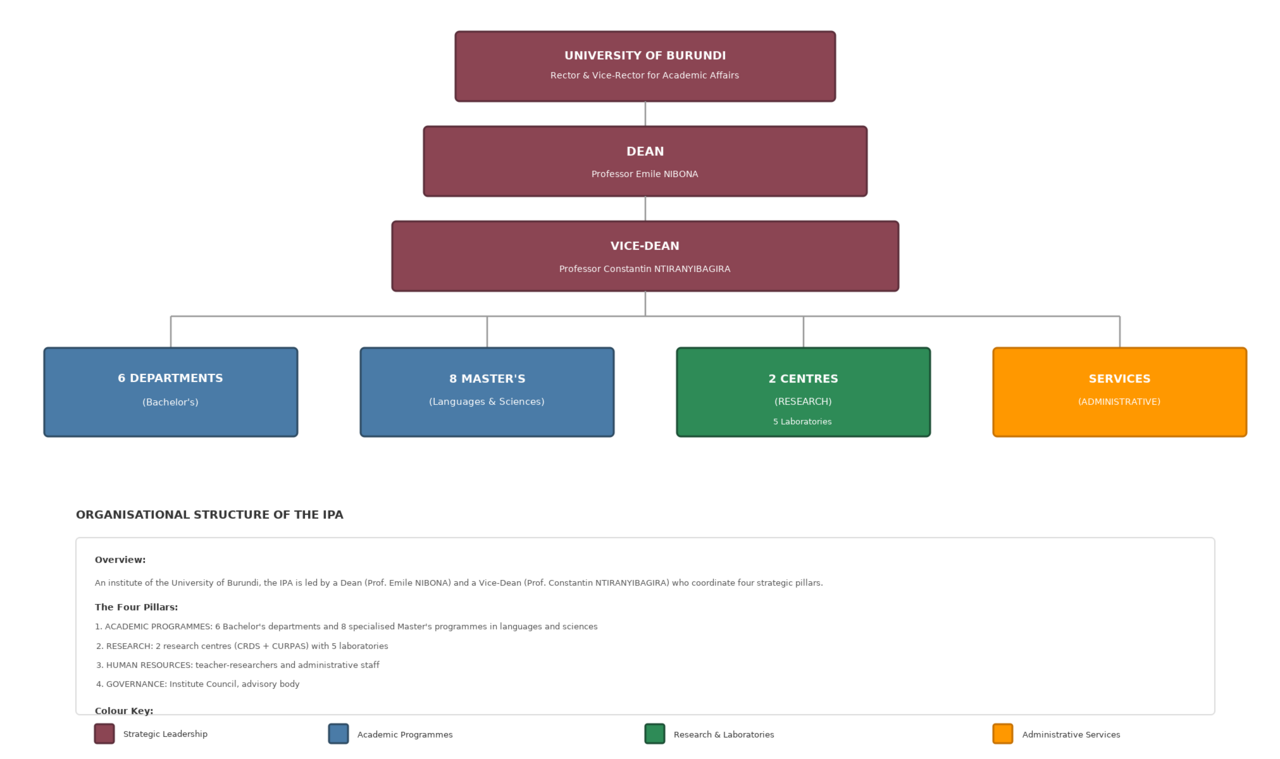
The Institute of Applied Pedagogy is part of the institutional structure of the University of Burundi, under the authority of the Rector and the Vice-Rector for Academic Affairs, alongside the Secretary General and the central Directorates (Directorate of Academic Services, Directorate of Research and Innovation, Directorate of Quality Assurance, Directorate of Finance and Assets, Directorate of Social Affairs). Within the IPA, the Dean provides strategic leadership and represents the Institute to the University, the Government of Burundi and international partners. The Vice-Dean is responsible for day-to-day operational management and the academic supervision of all programmes.
The IPA is organised around four integrated strategic pillars: Bachelor's programmes, Master's programmes, research centres and administrative services. This multi-level structure ensures coherence between advanced teaching, core teacher training, applied research and operational support.
Pillar 1: The six Bachelor's departments
The six Bachelor's departments are at the heart of the IPA's teaching mandate. The English Department prepares English teachers and second-language didactics specialists in a multilingual context. The French Department trains French teachers and French language teaching specialists for the Burundian and African context. The Kirundi-Kiswahili Department promotes African languages and trains educators to teach regional and national languages. The Mathematics Department trains teachers able to make mathematics accessible and motivating for learners. The Biology-Chemistry Department prepares teachers of the natural sciences, with an emphasis on experimental teaching and scientific inquiry. The Physics-Technology Department teaches the didactics of physics, technological applications and the integration of digital technology in education. Each department is led by a head of department and supervised directly by the Vice-Dean.
English Department
Training in English didactics, communicative teaching, English-language literature, and innovative teaching methods for second-language teaching in the Burundian context.
French Department
Training in French didactics, French language teaching, comparative literature, and pedagogy adapted to the African context. Prepares secondary school teachers and future educator-researchers.
Kirundi-Kiswahili Department
Training in African language pedagogy, the didactics of Kirundi and Kiswahili, promoting the teaching of regional and national languages, and valuing Africa's linguistic heritage.
Mathematics Department
Training in mathematics didactics, the teaching of quantitative sciences, problem-solving pedagogy, and preparing future secondary school mathematics teachers.
Biology-Chemistry Department
Training in natural science didactics, the teaching of biology and chemistry, experimental pedagogy, and preparing teachers able to lead practical activities and scientific inquiry.
Physics-Technology Department
Training in the didactics of physics and technology, applied science teaching, digital pedagogy, and preparation for the technological challenges of the 21st century in the African context.
Pillar 2: Master's programmes (Languages and Sciences)
The IPA offers eight specialised Master's programmes, in two groups, designed to train high-level educators and teacher-researchers able to transform Burundian education. In Languages, the Master's in TESOL (Teaching English to Speakers of Other Languages) trains specialists in English language didactics with a communicative and intercultural approach; the Master's in French prepares teaching specialists of the French language and experts in comparative literature; the Master's in Kirundi and in Swahili promote the national and regional languages and prepare educators to promote and teach them. In Sciences, the Master's in Biology, Chemistry, Mathematics and Physics train educator-researchers able to conduct applied research in their subject. These eight programmes are coordinated by their respective programme leaders under the academic supervision of the Vice-Dean.
Master's in TESOL
Specialised training in teaching English to speakers of other languages. A communicative, intercultural and pedagogical approach adapted to the African context.
Master's in Teaching French
Advanced training in French didactics, comparative literature and French language pedagogy for the Burundian and African context.
Master's in Teaching Kirundi
The national language, language mastery, oral and written literatures, promoting Burundi's heritage.
Master's in Teaching Swahili
The regional language of East Africa, cross-border communication, regional literatures and regional leadership.
Master's in Teaching Biology
Life sciences, direct observation, field experimentation, ecology and contemporary health issues.
Master's in Teaching Chemistry
Chemical sciences, from the macroscopic to the microscopic, molecular transformations, green chemistry and experimentation.
Master's in Teaching Mathematics
Logical and critical thinking, gradual conceptualisation, problem solving and real-world applications.
Master's in Teaching Physics
Physical sciences, observing natural phenomena, theoretical modelling, forces, energy and motion.
Pillar 3: The two research centres and five laboratories
Applied research, educational innovation and curriculum development are led by two major centres comprising five specialised laboratories. The Centre for Research in Didactics and Science Dissemination (CRDS) oversees two laboratories: the Research Laboratory for Science Didactics and Peace Education (REDISEPA) and the Laboratory for the Description, Didactics and Dynamics of Languages (3DL). The University Centre for Research and Pedagogy Applied to the Sciences (CURPAS) oversees three laboratories: the Laboratory of Exact and Applied Sciences (SEA), the Laboratory of Applied Nutrition-Phytochemistry, Ecology and Environment (LNPEEA), and the Laboratory for the Didactics of Sciences Applied to Teaching (DSAE). Together, these five laboratories conduct research in didactics, natural sciences, languages, nutrition, ecology and educational applications.
Centre for Research in Didactics and Science Dissemination (CRDS)
Leads research in didactics, curriculum development and science dissemination.
Comprises two laboratories:
- the Research Laboratory for Science Didactics and Peace Education (REDISEPA)
- the Laboratory for the Description, Didactics and Dynamics of Languages (3DL).
University Centre for Research and Pedagogy Applied to the Sciences (CURPAS)
Conducts applied research, educational innovation and practical applications of the sciences.
Comprises three laboratories:
- the Laboratory of Exact and Applied Sciences (SEA)
- the Laboratory of Applied Nutrition-Phytochemistry, Ecology and Environment (LNPEEA)
- the Laboratory for the Didactics of Sciences Applied to Teaching (DSAE)
Pillar 4: The five administrative services
The IPA's operational support rests on five specialised services. The IPA Library manages documentary resources, develops academic collections in pedagogy and the sciences, and offers reference services to students and teacher-researchers. The IT Service provides the technology infrastructure, maintains computer systems, supports academic and administrative applications, and facilitates the integration of digital technology into teaching and research. The Accounts Office manages the institution's finances, processes budget operations, ensures financial compliance and supports budget planning for academic excellence. The Maintenance Service looks after the IPA's facilities and equipment, ensures the safety of buildings and installations, and guarantees a functional and safe working environment. The Institutional Archives preserve the IPA's historical documents and records, manage administrative and academic files, and safeguard the institutional memory.
IPA Library
Manages documentary resources, develops collections in pedagogy and the sciences, offers reference services to students and teacher-researchers, and contributes to access to quality academic information.
IT Service
Provides the technology infrastructure, maintains computer systems, supports academic and administrative applications, and facilitates the integration of digital technology into teaching and research.
Accounts Office
Manages the Institute's finances, processes budget operations, ensures financial compliance and supports budget planning for academic excellence.
Maintenance Service
Looks after the IPA's facilities and infrastructure, ensures the safety of buildings, manages equipment, and guarantees a functional and safe working environment.
Institutional Archives
Preserves the IPA's historical documents and records, manages administrative and academic files, and safeguards the institutional memory.
Administrative Secretariat
Attached to the Institute's management, the Administrative Secretary coordinates the IPA's administrative staff and technicians. The administrative services handle the Institute's day-to-day operations, namely: administrative affairs, mail, archives, finance, the library, IT and maintenance.